
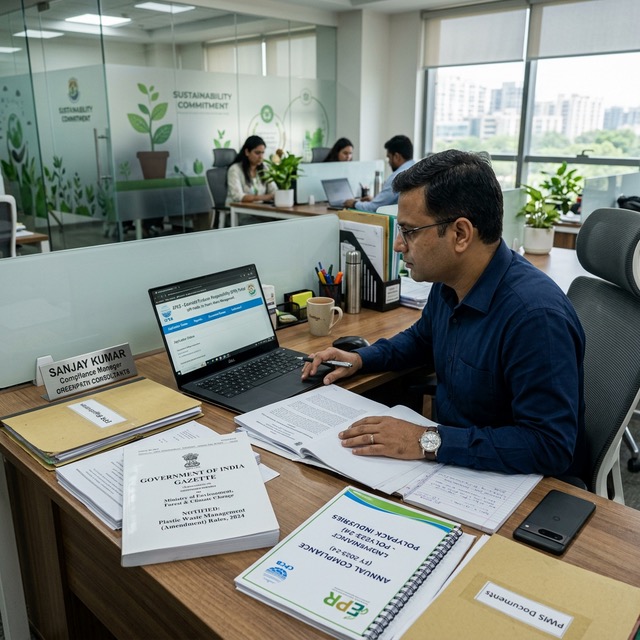
What is EPR?
Extended Producer Responsibility (EPR) is a policy approach under which producers take responsibility for the entire lifecycle of the products they introduce into the market — including end-of-life management for collection, transportation, and recycling.
In India, EPR is now legally mandated across multiple waste streams under the Environment Protection Act, 1986 and various rules framed thereunder:
Who Are PIBOs?
**PIBOs** — Producers, Importers, and Brand Owners — are the primary entities responsible for EPR compliance. If your company:
…then you are a PIBO and must comply with EPR norms.
The 5-Step EPR Compliance Lifecycle
**Step 1: Registration on CPCB EPR Portal**
Every PIBO must register on the centralized EPR portal at https://eprplastic.cpcb.gov.in or the e-waste equivalent. Required documents include incorporation certificates, turnover data, and sales volumes.
**Step 2: Determine Your EPR Target**
Based on your market placements in the previous financial year, CPCB assigns collection and recycling targets. These typically range from 20% to 100% depending on the category and year.
**Step 3: Strategic Waste Sourcing**
You must collect or arrange to collect the equivalent waste through CPCB-authorized collection centers, dismantlers, and recyclers. This is where a logistics partner like 3E Concepts is invaluable.
**Step 4: Verified Recycling & Certificates**
Waste must be processed at CPCB-authorized recyclers. You receive EST (Extended Producer Responsibility Certificates) as proof of recycling. These form your compliance trail.
**Step 5: Quarterly/Annual Reporting**
File fulfillment reports quarterly and annually on the CPCB portal. Non-compliance attracts heavy penalties — up to 3x the cost of non-collected waste.
Penalties for Non-Compliance
Failure to comply with EPR norms in India can result in:
How 3E Concepts Helps
At 3E Concepts, we manage the complete EPR lifecycle for our PIBO clients. From initial registration and gap analysis to waste sourcing, recycler coordination, certification, and filing — we provide a single-point, audit-ready service.
**Contact us today:** info@3econcepts.in | +91 99100 88435